
When Taking a Break Isn't Enough There are times when even our free time doesn't…
When craftsmanship becomes a rebirth
This month, we would like to share a first-person account: a journey of rebirth through craftsmanship, the reuse of materials and the discovery of new possibilities. A story that reminds us that giving an object a second life can sometimes also become a way of rediscovering a part of ourselves. This is Valentina’s story:
“Is it possible to turn pain into an opportunity?
Yes, it’s called resilience, and in my case it comes through fabric, lace and recycling.
The idea of leaving a better world for future generations has always been a cornerstone of my life, especially since becoming a mother. But the idea of making things better in this sense must start small, in our everyday lives, in other words, with our own hands.
So, before throwing ourselves into major initiatives, we can first try not to waste resources in our own little domestic planet, encouraging reuse and a no-waste mindset.
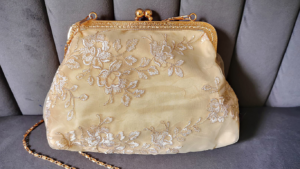
It was from this belief that my first handmade bag was born: La Fenice (The Phoenix).
The first bag
My Phoenix represents, in a nutshell, exactly what it is: a rebirth from the ashes of something that no longer exists. In my case, from the ashes of my wedding dress.
Yes, because the symbol of that wonderful day of celebration, after a divorce, risks becoming nothing but a source of bitterness. And since it is a very expensive dress – let’s be honest – why not give it a second life, transforming it into something that keeps thousands of euros’ worth of fabric, lace and beads from simply yellowing in a wardrobe, while allowing it to be enjoyed as a new symbolic accessory?
The idea of somehow reusing the fabric of my dress had been on my mind for some time, but I was waiting to decide how to do it.
The opportunity came when I became passionate about embroidered Victorian bags and more modern clasp-frame bags. From then on, there was a shower of emotions and… bags!
Deep roots
Since I am not a sewing professional but work in publishing, I had to learn how to sew from a seamstress: my mother. From her, I learned attention to detail and precision, becoming passionate about a world that had always been close to me, yet remained unfamiliar until that moment.
Working with my hands, for someone like me who spends so much time working with her mind, creates a balance between a sedentary – and sometimes repetitive – lifestyle and a dynamic yet creative one. In fact, making and/or restoring objects, even large ones, is something I have always done. From my father, a civil servant with a passion for DIY, I learned to understand and use carpentry and blacksmithing tools, to get my hands dirty, to design and take care of every aspect of making “solid” objects, unlike my mother, who has always worked with “soft” materials.
My education was in the humanities, as was my profession, but drawing, decorating and constantly exploring new techniques have never left me.
And today, I like to think that the path towards La Fenice had somehow already begun.
The materials
For someone like me, who is passionate about craftsmanship, making a bag brings together many small and exciting processes: research, matching materials, creativity, the value of the object and attention to detail.
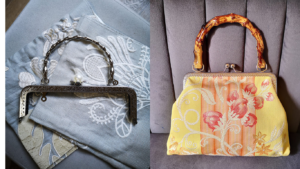
The fabrics I use must primarily be recycled, which offers an endless range of possibilities: from discarded clothes and household linens to old upholstery fabric sample books that are no longer in use. Nothing should be thrown away; everything has potential.
Antique markets and house-clearance sales often offer a variety of options, but combinations can also come from purchased fabric remnants or simply from the desire to give something a new lease of life.
I have only one requirement: the material must be in good condition.
A myriad of combinations
Once I have gathered everything I need, I move on to choosing the outer and inner fabrics of the bag, including trimmings, metal handles and any shoulder straps. Everything must come together in an energetic flow that reflects the origins of the fabric.
Let me explain. If, for example, a fabric was given to me with affection, that feeling must be reflected in the bag, so the combination I choose will be gentler and more delicate. If, on the other hand, there are no emotional associations, the bag reflects the nature of the fabric: soft and small for velvet, large and sturdy for jacquard, and so on.
I can make bags that look similar, but each one is always a one-of-a-kind piece, because the combinations and decorations change every time. I also pay close attention to how the design will be framed on the finished bag, so if I am not convinced, I wait until I find a material that inspires me more.
Bags as metaphors
The bags I make must be beautiful on the outside, but also on the inside, because it is within that the beauty of genuine and honest people shines. Bags are therefore a metaphor.
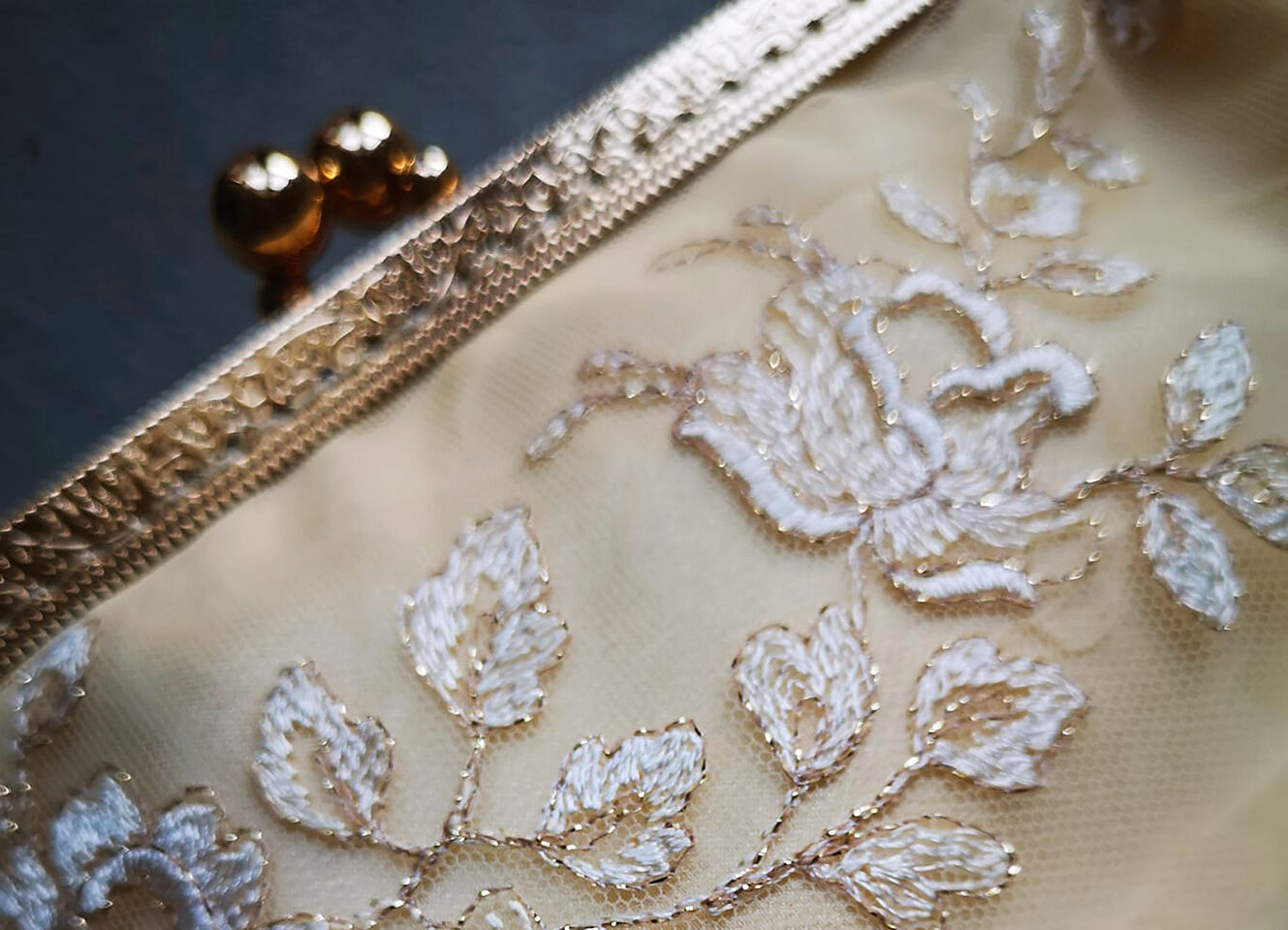
La Fenice was made on the outside using the lace from the bodice of my wedding dress, finished with the tulle from the underskirt and lined inside with satin from the train and lace.
Hidden among its seams is a grain of rice that had remained trapped in the bodice. The dress had never been washed, because a common belief says that a wedding dress should not be cleaned after being worn, as doing so would mean wanting to wear it again. But my marriage ended anyway, even though I had never washed it.
Furthermore, since the promises made on that day had been broken, the dress represented, at least to me, a garment stained by lies. Turning it into a metaphor was a natural next step.
What came back to me
Having found the strength to make La Fenice and then show it, even with a little pride, amplified the sense of well-being and the positive response to this gesture, which is culturally unacceptable in certain respects.
Of course, I started with a smaller circle of people, differing in age and educational background, but since I began making these bags, opinions, thoughts and stories have come back to me. Because everyone has an event that has left its mark on them and that they want to talk about, if they feel welcomed.
My “making with my hands” has brought so many words along with it, opened hearts, and created shared spaces and moments. I am very happy about this. And I am only just beginning.
Valentina
Stories like this also reveal the value of upcycling: learning to look at what already exists with fresh eyes, recognising the potential of materials and transforming them into original creations.
This is one of the things we explore in Creative Italy’s Upcycling courses: experimenting, reusing, designing and discovering how creativity can open up new paths, even when starting with something that once seemed to have no further purpose.
Because sometimes, bringing something new to life simply means learning to see what we already have differently.
Related Posts

Comments (0)